
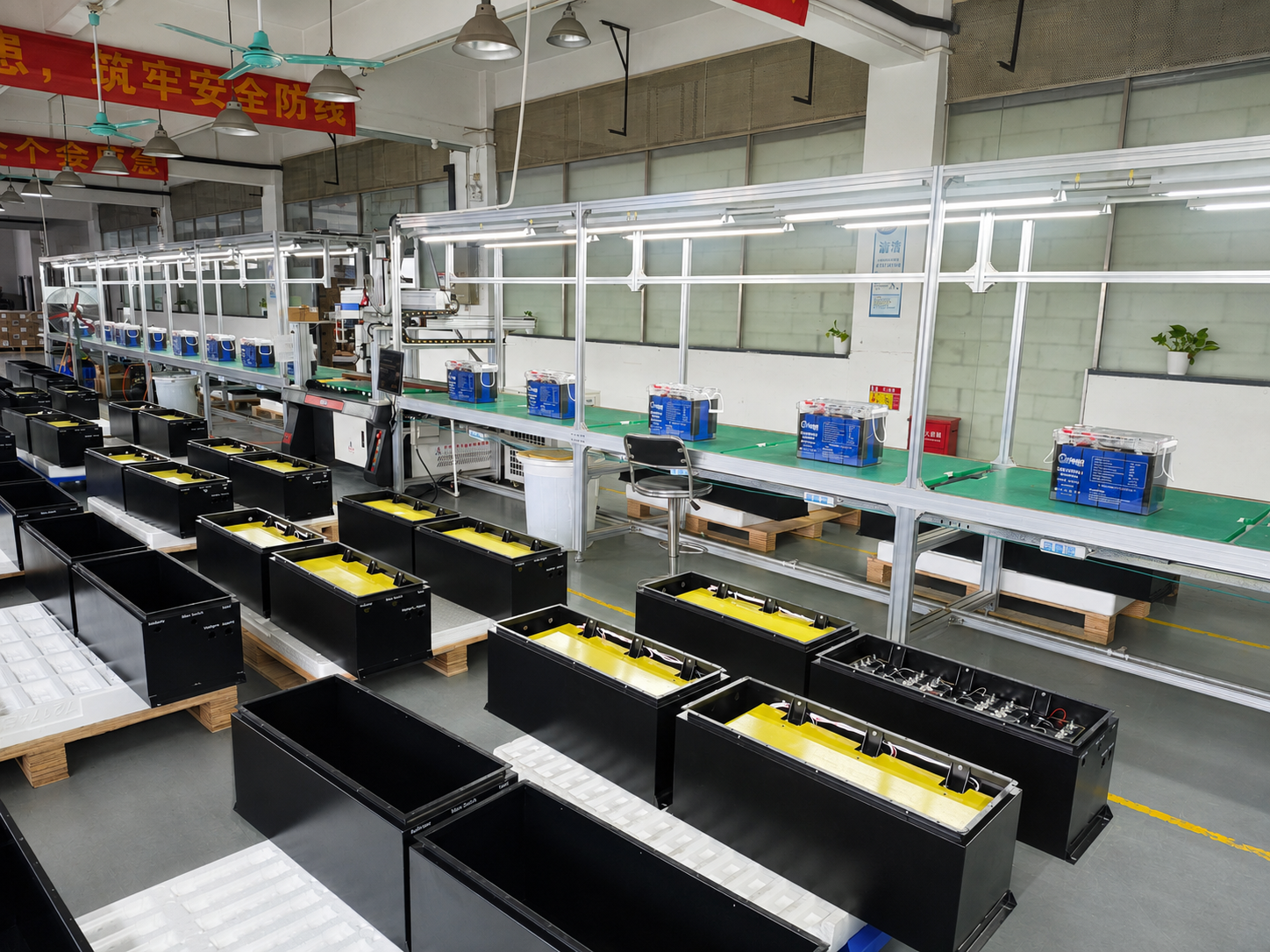
Our LFP battery assembly line — semi-finished packs lined up before final casing, wiring and BMS testing.
Electric tricycles, e-rickshaws and Tuk Tuks are quietly becoming the workhorses of last-mile delivery across India, Nepal, Bangladesh, Southeast Asia, Latin America and East Africa. For importers, distributors and fleet operators, the biggest buying decision is no longer the vehicle itself — it is the battery pack sitting under the seat. This guide walks through the specifications, trade-offs and factory-negotiation points that actually matter at the wholesale level.
Why LiFePO4 Powers Commercial Three-Wheelers
LiFePO4 (LFP) chemistry is engineered for exactly the duty cycle a commercial three-wheeler puts it through: deep daily discharge, rapid opportunity charging, long operating hours and exposure to high ambient temperatures. A well-built LFP pack delivers 4,000 deep cycles at high depth of discharge, holds a flat voltage curve through the working day, and stays thermally stable even in tropical climates and on slow, stop-and-go urban routes. It is also significantly lighter per kWh than older battery chemistries, which directly improves payload, range and suspension wear on the vehicle.
51.2V vs 60V vs 72V — Which Platform Fits Your Market?
E-tricycle OEMs around the world cluster on three nominal voltage platforms. Choosing the right one for your region is the first wholesale decision you will make.
- 51.2V (16-cell LFP): the rising global standard, common on newer export-oriented Tuk Tuk platforms and on conversion kits. Lower pack voltage means gentler current draw and easier BMS tuning.
- 60V: the dominant legacy platform across Indian e-rickshaws, the Nepalese and Bangladeshi passenger rickshaw fleets, and many Southeast Asian cargo trikes. If your market is already flooded with 60V vehicles, stocking a 60V pack means instant compatibility.
- 72V: used on heavier cargo trikes, hill-country routes and longer-range passenger Tuk Tuks, where higher voltage means lower current for the same power and less stress on wiring and controllers.
As a distributor, you do not have to pick one — but you should know which platform your local OEMs and used-vehicle fleet already run, because cross-platform packs are not interchangeable.
Electric rickshaw on a busy street in Varanasi, India — the daily operating environment for LFP-powered three-wheeler fleets across South Asia.
Matching Capacity (50Ah–200Ah) to Real Daily Routes
Battery capacity is not a “bigger is better” decision. A 50Ah pack is enough for a city passenger Tuk Tuk doing short, flat loops; a 150Ah–200Ah pack is what a cargo operator on a 100+ km rural route actually needs. Overspecifying adds weight and cost that the vehicle’s suspension and frame were not designed for. Underspecifying means midday swaps, which kills the operator’s economics. When you spec a container from the factory, split the order — for example, 50Ah packs for urban passenger fleets and 100–200Ah packs for cargo and rural routes — rather than buying a single capacity for the whole market.
What Distributors Should Actually Look for in the BMS
The battery management system is the single failure point that most distributors under-audit. Before you place a container order, ask the factory for: cell-level voltage monitoring (not just pack-level), a low-temperature charging cutoff (important if your market sees cool nights, such as Kathmandu valley winters), balanced charge current, and a communication protocol that matches the local motor controller (CAN, UART or RS485). Also ask whether the BMS can be custom-programmed — for example, to limit charge voltage for a battery-swap PAYG model, or to tune discharge curves for hilly terrain. This is exactly the kind of OEM/ODM flexibility that separates a trading company from a real factory partner.
Rough Roads and Tropical Heat: Durability Specs That Matter
A battery pack that works in a controlled European test lab is not the same pack that survives a Dhaka alley, a Kathmandu hillside road or a Tanzanian rainy season. Ask factories about: IP rating (IP54 minimum for splash and dust, IP65 where exposed), reinforced casing and mounting brackets that resist vibration fatigue, cell-level isolation against chassis flex, and an operating-temperature range that covers your summer highs. Deep discharge recovery matters too — commercial rickshaws regularly run the pack to near zero, and a pack that thrashes itself at 100% depth of discharge will not hit its advertised cycle life in the field.
OEM/ODM, MOQ and Private Label: What to Negotiate With the Factory
As a B2B buyer, you should not accept a “one-size” retail pack. A serious factory partner should offer:
- Private-label casing and branding under your own brand name.
- Flexible MOQ — small trial containers for market validation, then volume pricing for regional stock.
- Certification support — UN38.3 for shipping, and CE / local market compliance documents ready on request.
- Warranty terms in writing — typically 2–5 years or 4,000 cycles, whichever comes first, with a clear replacement process.
Evaluating Total Cost on Your Next Purchase Order
When you compare two factory quotes, do not stop at the sticker price. Estimate: how many cycles the pack will deliver over the contract life, how much usable energy you get per charge (LFP packs safely deliver 90–95% depth of discharge), expected fleet downtime per swap event, and how warranty claims are actually processed in your region. A higher-spec pack that hits its 4,000-cycle rating in the field almost always wins on a cost-per-kilometre basis for commercial fleets — which is exactly why PAYG operators, battery-swap networks and regional distributors across South Asia and East Africa are standardising their replenishment orders around LFP.
Why Work With a Specialist LFP Manufacturer
At Yauneidak, we manufacture LFP deep-cycle packs built specifically for electric tricycles, rickshaws and Tuk Tuks — available in 51.2V, 64V and 72V platforms from 50Ah to 200Ah, with 4,000-cycle cells, custom BMS programming and full private-label support. Request a distributor quotation and tell us which voltage platform your market runs; we will spec the pack, the casing and the BMS profile around your customers, not around a catalog SKU.


