
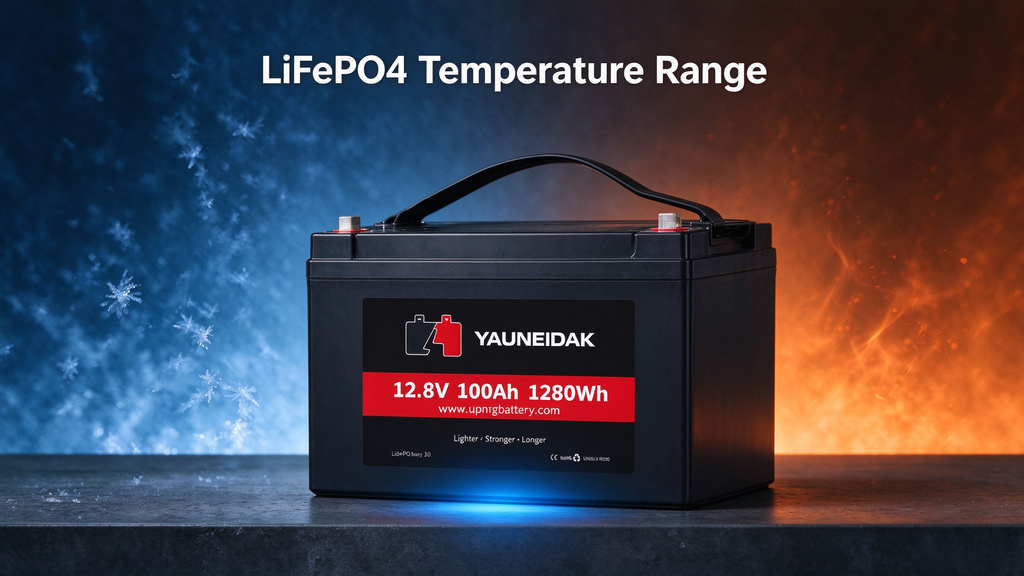
Caption: Yauneidak 12.8V 100Ah LiFePO4 battery — engineered for reliable performance across temperature extremes.
For distributors, EPC contractors, and solar installers sourcing lithium iron phosphate (LiFePO4) batteries, the temperature range is not just a technical spec on a datasheet — it is the single factor that determines whether your product survives in the field, earns repeat orders, or triggers warranty claims. Unlike lead-acid, LiFePO4 chemistry is highly temperature-sensitive. Cross the wrong threshold, and the battery may not fail immediately, but it will silently lose capacity, shorten its cycle life, or — in worst cases — trigger safety protection.
This guide breaks down the official operating limits, what actually happens inside the cell at extreme temperatures, and the practical rules your installation team should follow on site.
Why Temperature Matters for LiFePO4 Performance
Every electrochemical reaction inside a battery depends on ion movement between the cathode and anode. Temperature directly controls how fast those ions travel through the electrolyte.
At moderate temperatures (roughly 15°C to 35°C), the chemistry works as designed: internal resistance stays low, voltage stays stable, and the battery delivers its rated amp-hour capacity. Outside this window, things start to shift. High temperatures accelerate electrolyte breakdown and degrade the solid-electrolyte interphase (SEI) layer on the anode. Low temperatures thicken the electrolyte, slow down ion diffusion, and can cause lithium plating — a permanent damage mechanism that no BMS can reverse.
For buyers shipping to tropical markets such as East Africa, or to cold-climate regions, understanding these limits is the first step toward specifying the right BMS protections and mounting recommendations.
The Official LiFePO4 Temperature Limits
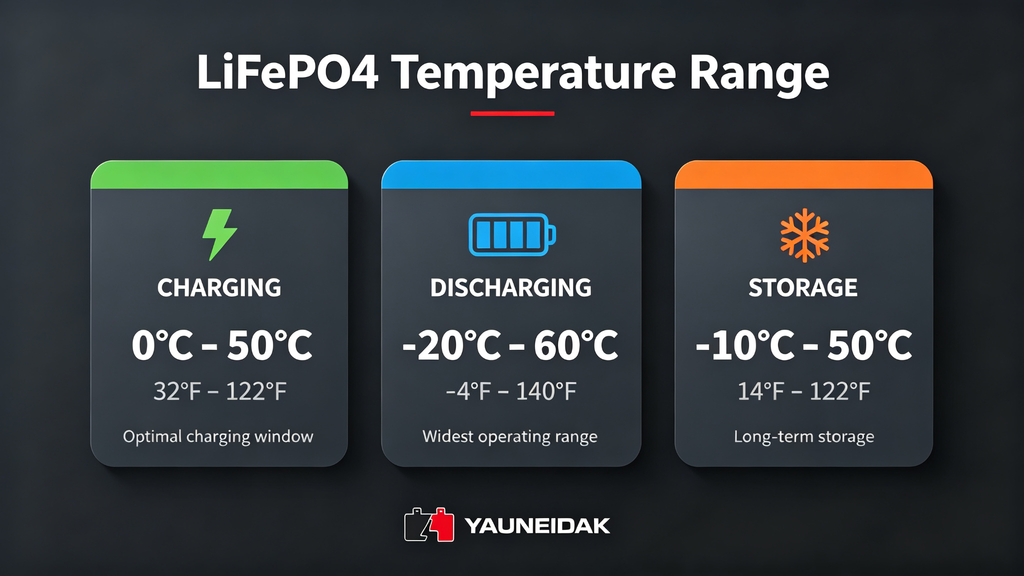
Caption: LiFePO4 batteries operate within defined temperature windows for charging, discharging, and storage. All three ranges are not interchangeable.
Reputable LiFePO4 manufacturers publish three separate temperature ranges. They are not interchangeable, and confusing them is a common source of field failures.
Charge Temperature. LiFePO4 batteries should only be charged between 0°C and 50°C. Charging below 0°C forces lithium ions to plate onto the anode surface instead of intercalating into the graphite structure. This lithium plating is largely irreversible and creates dendritic growth that can pierce the separator over time. Charging above 50°C accelerates side reactions and permanently thins the active material.
Discharge Temperature. The discharge window is wider, from -20°C to 60°C. At the cold end, expect reduced available capacity — a battery may deliver only 60–70% of its rated Ah at -10°C. At the hot end, discharge works fine but cycle life drops.
Storage Temperature. Whether a pack sits in your project warehouse, on a dealer shelf, or in transit between the factory and your jobsite, store it between -10°C and 50°C, ideally at a 40–60% state of charge. A battery shipped from the factory at a healthy 50% SOC that then spends two weeks in a sealed 60°C shipping container will arrive pre-aged — that cycle life you counted on is already gone before the installation crew unboxes it.
What Happens When Temperatures Go Too High
Above 60°C, the risk profile changes. Electrolyte begins to break down, the SEI layer grows thicker, and internal resistance climbs. A battery that still works at 60°C will see its cycle life drop sharply — what should last 3,000 cycles may degrade to 1,500 or fewer.
In extreme cases, sustained high heat combined with overcharging can trigger thermal runaway. Modern LiFePO4 cells are much more stable than NMC chemistries, and the phosphate cathode is inherently thermal-runaway-resistant, but the BMS still has a cut-off threshold — typically around 60°C to 70°C — where it will disconnect the pack to protect itself.
For field installers, this means: never mount LiFePO4 packs in direct sunlight on a metal rooftop, never enclose them in an unventilated cabinet, and never place them next to a generator exhaust.
What Happens When Temperatures Drop Too Low
Cold weather is more dangerous for charging than for discharging. At -20°C, a LiFePO4 battery can still deliver power — but sluggishly, with reduced capacity and lower voltage. Many users panic when their battery gauge drops in winter, not realizing the capacity returns once the cell warms up.
The real danger is attempting to charge below 0°C. Once the cell drops below freezing, lithium can no longer embed itself cleanly into the graphite anode and begins depositing as metal on the surface. A quality BMS will disable charging when cell temperature drops below the threshold (usually 0°C or -5°C), and re-enable it only when the pack warms back up. Buyers should always confirm whether the BMS on the pack they are sourcing has this low-temperature charge cutoff — not all budget modules include it.
Thermal Management Tips for Distributors and EPCs
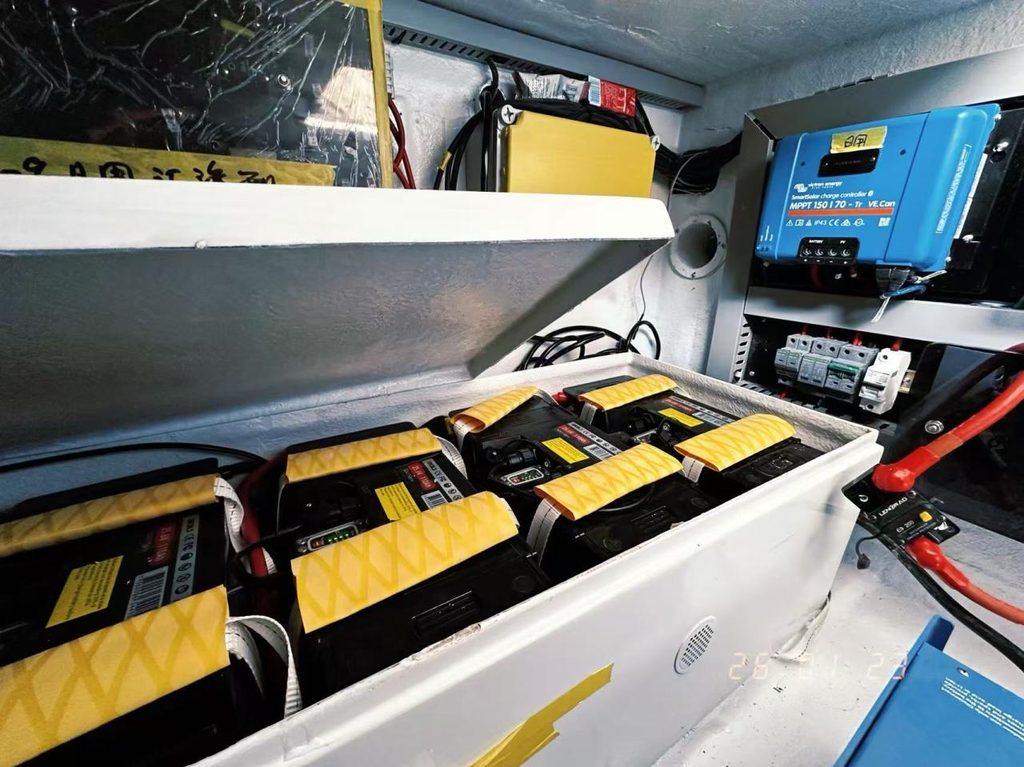
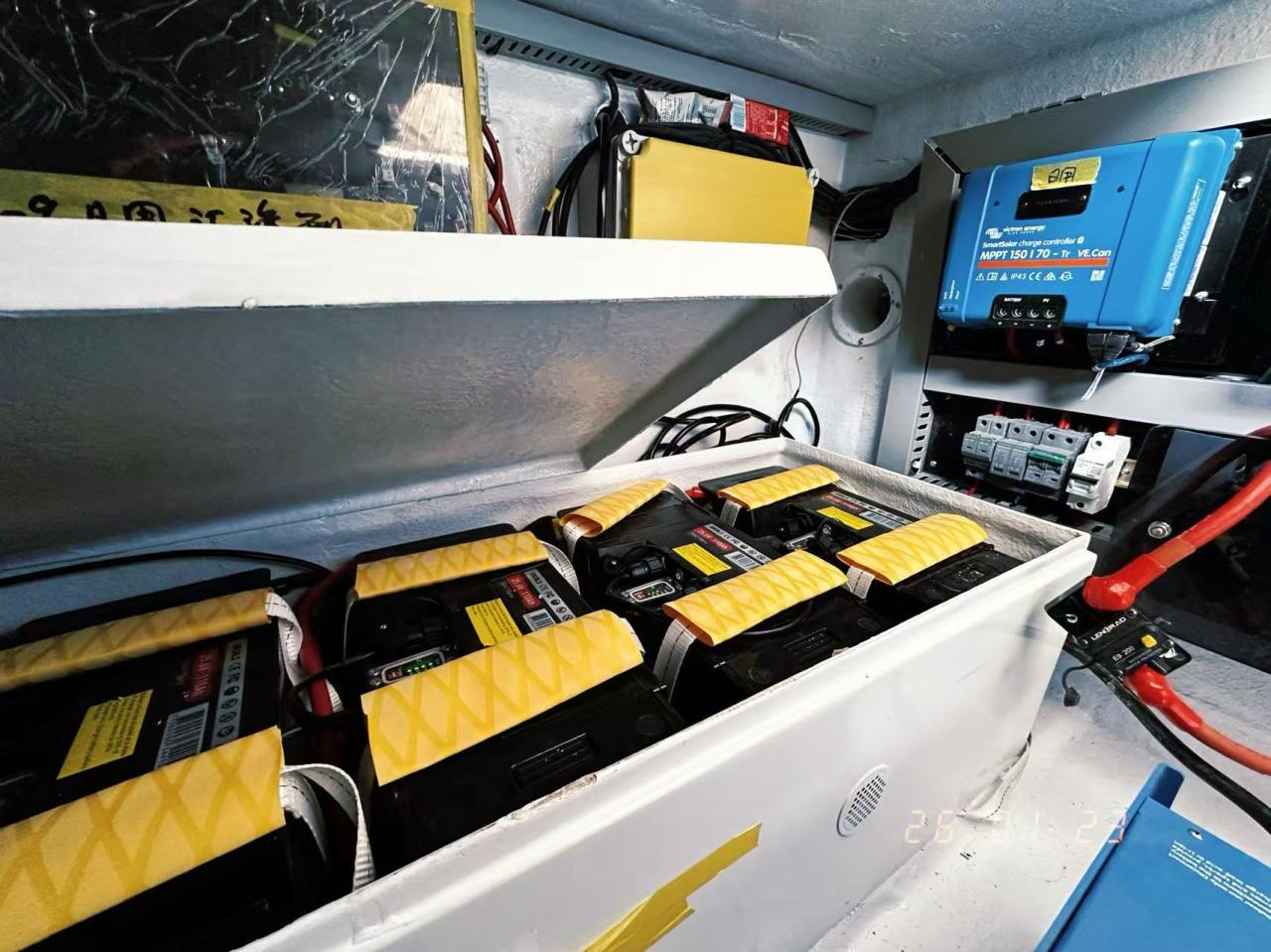
Caption: A properly vented marine battery compartment with multiple LiFePO4 packs and a Victron SmartSolar MPPT charge controller. Note the ventilation gaps and organized cable routing.
- Specify the right BMS. Look for pack-level temperature sensors, low-temp charge cutoff, and high-temp disconnect. For off-grid solar systems in hot climates, active or passive cooling beats sealed enclosures.
- Mount packs in shade. In tropical installations, vented battery enclosures under a roof overhang perform far better than sun-exposed cabinets. A 10°C reduction in operating temperature can double service life.
- Confirm factory-shipped SOC, not warehouse storage. Since most quality LiFePO4 packs are built to order and shipped direct from the production line, ask your supplier what SOC level the cell leaves the factory at (it should be around 50%). This is not a “warehouse log” — it is a factory state-of-charge declaration on the packing list. During peak-season ocean freight to tropical destinations, request container temperature guidance or schedule shipments away from the hottest weeks if your project timeline allows.
- Use LiFePO4-specific chargers. Lead-acid chargers deliver incorrect voltage profiles and can overcharge a LiFePO4 pack, generating unnecessary heat.
Common Mistakes That Shorten Battery Lifespan
The most frequent field failures are not caused by defective cells — they are caused by operating outside the temperature envelope. The four mistakes we see most often:
- Charging a battery that has been sitting overnight below freezing.
- Mounting packs in an unventilated, sun-facing enclosure.
- Leaving freshly delivered packs at 100% SOC inside a hot site container or locked metal cabinet after arrival.
- Pairing LiFePO4 batteries with legacy lead-acid chargers.
Each of these is preventable with basic installation guidelines — and each one is avoidable warranty cost.
FAQ
How cold is too cold to charge a LiFePO4 battery?
Below 0°C, charging should be disabled. A properly configured BMS will handle this automatically.
Can LiFePO4 batteries handle African heat?
Yes, within their discharge range. The critical factor is proper ventilation and shading during installation — not the chemistry itself.
Does temperature affect battery warranty?
Most manufacturers void warranty for damage caused by operation outside published temperature ranges, including unregulated thermal exposure.
Conclusion
The LiFePO4 temperature range exists for a reason. Staying within the charge, discharge, and storage windows is the simplest, lowest-cost way to ensure the batteries you source deliver their advertised 3,000–6,000 cycle life in the field. For distributors and EPC partners, that translates directly into fewer returns, happier end customers, and a stronger reputation for the brand you represent.
If you are specifying LiFePO4 packs for off-grid solar, RV, marine, or starter-battery applications and need BMS temperature protection tailored to your local climate, our engineering team can help you configure the right pack for your market.
.jpg)
.jpg)
.jpg)